Third roadshow event: Managing nutrients in intensive livestock production – Lessons from Norway
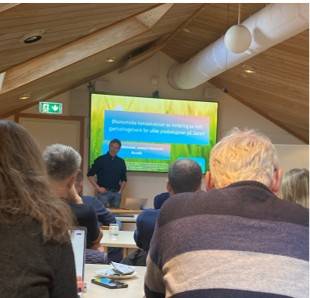
On March 3, 2026, the third event of the LAMASUS roadshow titled “Managing nutrients in intensive livestock production” was organized by project partners at Ruralis.
The event gathered about 30 participants, representatives of farmers, dairy cooperative, meat cooperative, grain cooperative, extension service, county governor, a private bank, and farmer organizations.
Participants discussed the management of nutrients in intensive livestock productions, with a focus on the specificities of Norway and evolution of livestock/cereal regions since the 1950’s.
Starting point: the long shadow of policies
Modern livestock production is often presented as a story of efficiency, but it comes with a hidden cost: it can weaken the natural link between crop farming and animal farming. As agriculture becomes more specialized, nutrients no longer circulate within the same local system. Instead, feed is produced in one place, animals are raised in another, and manure accumulates far from the land that could use it most productively.
Focus on the Norway use-case
Norway illustrates this dynamic well: over the second half of the 20th century, agricultural policy encouraged a separation between grain production and livestock farming. Eastern Norway, with its fertile soils, became increasingly focused on cereals, while livestock production was concentrated in other regions. This created a one-way nutrient flow: feed moved into livestock areas, but the nutrients embedded in manure did not return in the same way to the cereal-producing land. The result is a structural imbalance, with environmental pressure building in livestock-dense regions while crop regions lose an important source of fertility.
Learnings, discussions and future directions
The broader lesson is that agricultural sustainability cannot be measured by production alone. The Norway case suggests that when farming systems are reorganized for specialization, they may become economically efficient while also becoming ecologically fragmented. Looking ahead, a more circular approach should be favoured, in which nutrient management is treated as a system-wide challenge, reconnecting livestock and crop production so that environmental stewardship becomes part of agricultural planning rather than an afterthought.
Participants also had the opportunity to discuss the LAMASUS Dashboard and tools and their implementation in practice.