Rethinking Farming on Peatlands: Insights from the LAMASUS Roadshow in the Netherlands
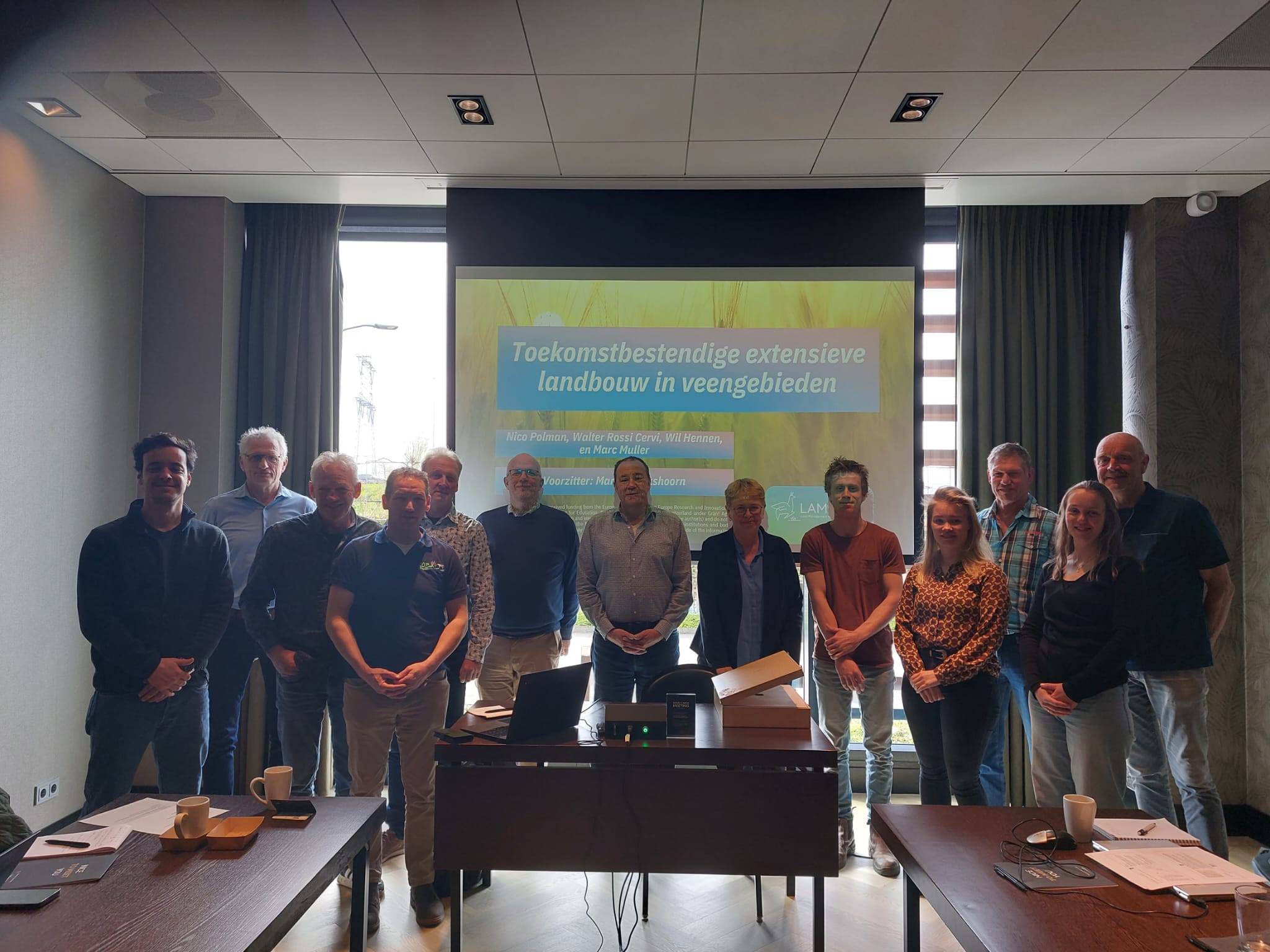
On April 10, 2026, stakeholders from across the agricultural and policy landscape gathered in Breukelen, the Netherlands, for a LAMASUS roadshow focused on the future of farming in peatland areas. Bringing together researchers, policymakers, and practitioners, the event explored a central question: how can agriculture on low-productivity soils remain economically viable while contributing to climate and environmental goals? Peatlands play a crucial role in carbon storage, but when drained for agriculture, they become a major source of greenhouse gas emissions. At the same time, they are deeply embedded in food production systems. In the Netherlands, for example, around 20% of intensive dairy farming takes place on peat soils. Balancing these environmental and economic realities is therefore a key challenge.
Modelling the transition: trade-offs between productivity and sustainability
During the roadshow, LAMASUS partner WUR presented insights from modelling work, which combines historical data, policy analysis, and simulation tools to explore how land use and agriculture may evolve up to 2050. Two contrasting policy pathways framed the discussion: one on maintaining productivity, with limited additional environmental constraints; the other on strong environmental ambition, aligned with the EU Green Deal, biodiversity targets, and large-scale peatland restoration. These scenarios illustrate how different policy choices can significantly influence both land use and farm structures. The results point to a gradual transformation of peatland agriculture: grassland areas are expected to decline under all scenarios, particularly where environmental ambitions are highest. At the same time, dairy cow numbers remain relatively stable, suggesting that farms may adapt through intensification or structural changes rather than reducing production altogether.
The economic reality for farmers
While environmental benefits are clear, the economic implications for farmers are complex. Raising groundwater levels, a key measure for reducing emissions, leads to lower grassland productivity. This can increase reliance on feed imports and put pressure on farm income. Although policy payments are available to support this transition, they are often temporary. The analysis presented during the roadshow assumes that additional payments end after 2028. Under these conditions, farm incomes decline over time, as lower productivity and higher input needs begin to outweigh the benefits of subsidies. This raises important questions about the long-term design of policy support. Short-term compensation may help initiate change, but sustained economic viability will likely require more stable incentives, new business models, or alternative revenue streams. At the same time, collaboration is emerging as a key part of the solution. In the Netherlands, for instance, subsidies encourage farmers to work together on water management at landscape scale, helping to raise groundwater levels more effectively and reduce emissions across entire peatland areas.
Looking ahead
The LAMASUS roadshow in Breukelen highlighted that the transition to sustainable peatland agriculture is not just a technical challenge, but a systemic one. It involves rethinking how land is used, how farmers are supported, and how environmental goals are integrated into economic realities. By combining modelling insights with stakeholder dialogue, LAMASUS is helping to shape a more informed debate about the future of agriculture in Europe. The path forward will depend on finding the right balance between productivity and sustainability, short-term support and long-term resilience, and local action and European ambition.